
Mobile charging hub for electric construction equipment at construction sites and infrastructure projects
A mobile charging hub provides immediate charging capacity at construction sites and infrastructure projects where grid power is unavailable or overloaded. With the rapid electrification of heavy equipment and ongoing grid congestion, flexible power is essential. Bryntell’s modular CleanStar generators let you quickly set up a temporary or semi-permanent charging hub to charge all your work equipment.
Always power for
heavy electric equipment
Always power for heavy electric equipment
Tailored to power capacity and emissions requirements
At Bryntell, we carefully size systems based on power requirements and applicable emissions standards. Never pay too much for capacity or features that your project doesn’t require. Target the restrictions that apply at your site, including nitrogen regulations, soot and particulate requirements, and guidelines for locations where no harmful CO2 emissions are permitted.
Standalone charging hub or as part of a hub
- Standalone charging site: The very short installation time makes the CleanStar ideal for projects that need to start tomorrow and require power immediately.
- Connect it to a battery (BESS): Use the battery when electricity demand is lower, and let the CleanStar run when energy demand is higher.
- Part of an energy hub: Use the CleanStar as a power source within a larger hub. Have it work alongside solar panels, batteries and an Energy Management System.
All the benefits of diesel
Bryntell has removed the logistical barriers to clean generators. The CleanStar works just as simply as traditional diesel solutions: easy to transport and install, with high energy density in a compact tank. The CleanStar offers the ‘sweet spot’ between diesel and complex alternatives such as hydrogen. Delivered entirely as a “Power-by-the-hour” service. We handle installation, fuel, maintenance and removal.
Sustainable continuity
Sustainable progress rests on two important pillars. On the one hand, there is operational reliability: you want business processes to continue non-stop to achieve growth. On the other hand, our times call for environmental responsibility, with polluting processes giving way to green alternatives. With Bryntell’s CleanStar, you bring these worlds together. We guarantee a reliable power supply at construction sites, (air)ports and real estate projects, with both your business and the environment in mind.
Bryntell CleanStar.
Scenarios and data sheets
No power outages when charging simultaneously.
Situation 1 – small construction site:
- Situation: 3 excavators (50 kW) and 1 heavy concrete mixer (150 kW) plug in at the same time.
- The calculation: With a realistic simultaneity factor of 70%, 210 kW of continuous power is required.
- The solution: A single 250 or 300 kW CleanStar generator handles this effortlessly as a standalone unit.
Situation 2 – large-scale infrastructure project:
- Situation: A large-scale asphalt project where an entire fleet of heavy machinery and 4 dumper trucks (each using 150 kW DC fast charging) plug in simultaneously during a shift change.
- The calculation: At that moment, the total simultaneous peak demand reaches 550 kW of continuous power.
- The solution: Using two CleanStar units connected in parallel provides a flexible 600 kW power plant. This handles the huge peak loads and prevents the charging process from grinding to a halt.
Scenario 1 – small-scale, short-term infrastructure project:
- Scenario: A 5-day infrastructure project where 4 dump trucks (400 kWh) are fully charged every night.
- The calculation: This requires a weekly energy demand of 8 MWh.
- The solution: Thanks to its tank capacity of 15 to 50 MWh, this project can run non-stop for 2 to 6 weeks without Bryntell having to refuel.
Situation 2 – large-scale, long-term infrastructure project:
- Scenario: A large, long-term infrastructure project lasting 4 weeks, far outside the urban area and with no grid connection. A large fleet of 12 heavy dump trucks (400 kWh each) needs to be charged intensively every day.
- The calculation: This requires a massive total energy supply of 96 MWh for the entire project.
- The solution: By connecting two CleanStar units (each with a capacity of 50 MWh) in parallel, you create a total energy buffer of 100 MWh. The project can run entirely autonomously for the full month on a single tank, without the logistical hassle of constant fuel deliveries to the site.
Situation 1 – Heavy-duty zero-emission tender in a Natura 2000 area:
- Situation: A large-scale dike reinforcement project right next to a vulnerable nature reserve. To obtain the permit, an entire fleet of heavy piling rigs, concrete mixers and cranes must be charged simultaneously at full power (900 kW peak demand) with ultra-low emissions. A traditional diesel generator park of this size would consume 7,500 liters of diesel per week.
- The calculation: Diesel would cause over 24 tonnes of CO₂ emissions here, as well as substantial, unacceptable nitrogen oxide (NOx) emissions per week.
- The solution: By connecting three CleanStar units in parallel, you can immediately supply the required 900 kW. Because the CleanStar running on biomethanol reduces nitrogen emissions to virtually zero and delivers net-zero CO₂ emissions, you save over 21 tonnes of CO₂ per week (up to a 90% reduction). The nitrogen calculation (AERIUS) immediately turns green, allowing the critical permit to be granted right away.
CleanStar datasheets
Examples of a
mobile charging hub
Examples of a mobile charging hub
Mobilis
Reliable energy and continuity on the construction site. We supplied infrastructure contractor Mobilis with 250 kW of continuous power, without nitrogen deposition. This kept the construction site running autonomously.


Schiphol (TCR-KES)
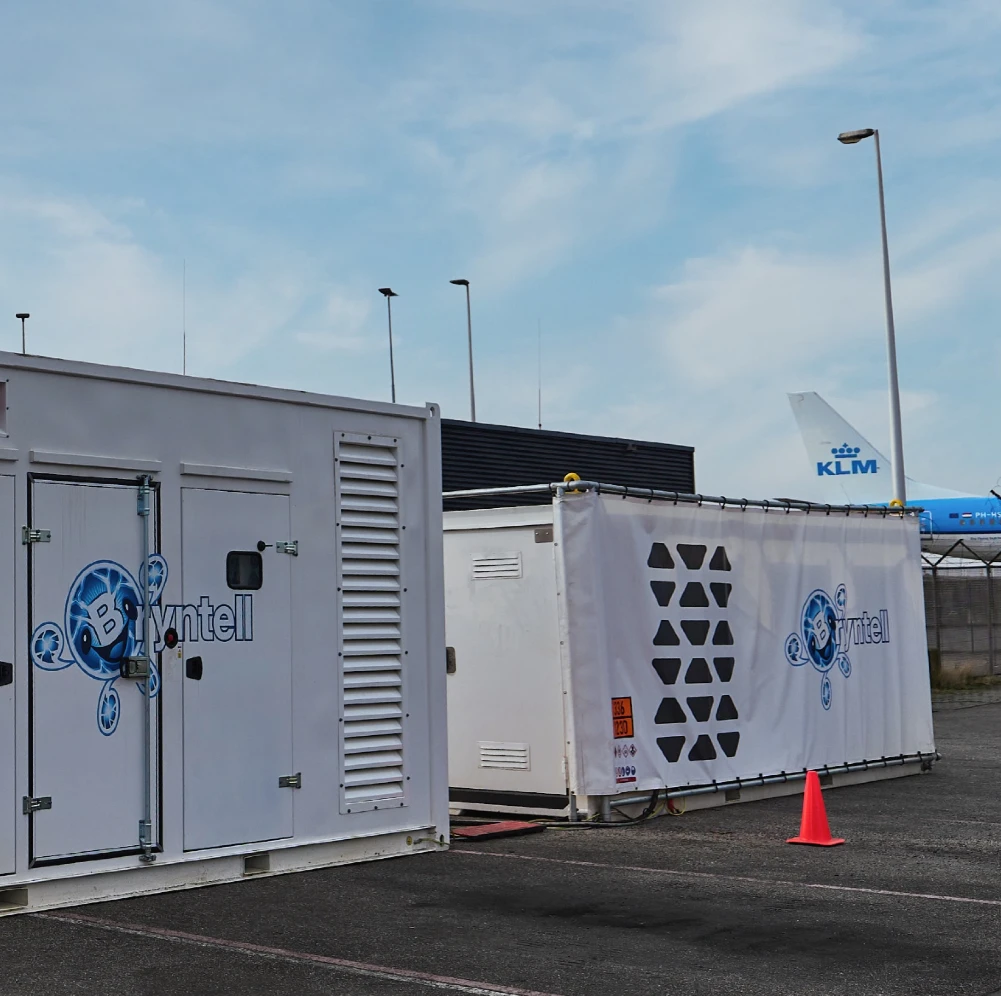
Electric airport transport is already possible. A successful pilot by Bryntell and TCR-KES at Schiphol proves it. Ground support equipment, including that of KLM, was charged without any issues.
Mobile charging hub FAQ
Mobile charging hub FAQ
In almost all cases, a grid-parallel setup for the CleanStar must be coordinated with the grid operator (such as Liander, Enexis or Stedin). Bryntell provides support and advice for all these applications.
If the grid voltage drops, the CleanStar's control system detects it immediately. The system disconnects from the grid within a fraction of a second and seamlessly switches to island mode, supplying energy entirely on its own. This allows your business operations to continue without any noticeable interruption.
The CleanStar continuously monitors power demand and the load on your grid connection. As soon as demand threatens to exceed the contracted transport capacity (GTV), the system automatically and seamlessly supplies the missing power. The system also provides extra power during expensive peak periods. This ensures you never pay too much in high energy tariffs or unnecessary fines from the grid operator.
Calculate your project
with the Bryntell specialists
Calculate your project
Custom quote
Let’s meet!
Let’s
meet!
Clean energy, flexibly deployed
anytime, anywhere
Let’s meet!
Let’s
meet!
Clean energy, flexibly deployed
anytime, anywhere
Let’s meet!
Clean energy, flexibly deployed
anytime, anywhere
